
How Concentration Choices Move the Development Calendar
Concentration looks like a formulation decision and behaves like a scheduling one. Raise the oil load and the number of available materials shrinks against their use limits, which usually means more sampling rounds. Change the format from spray to roll-on and the testing changes. Insist on a 25 percent extrait in a refillable format and the stability programme gets longer before a single bottle is filled. Buyers who plan the calendar from the fill date backwards without accounting for those effects find the slack in the wrong place.
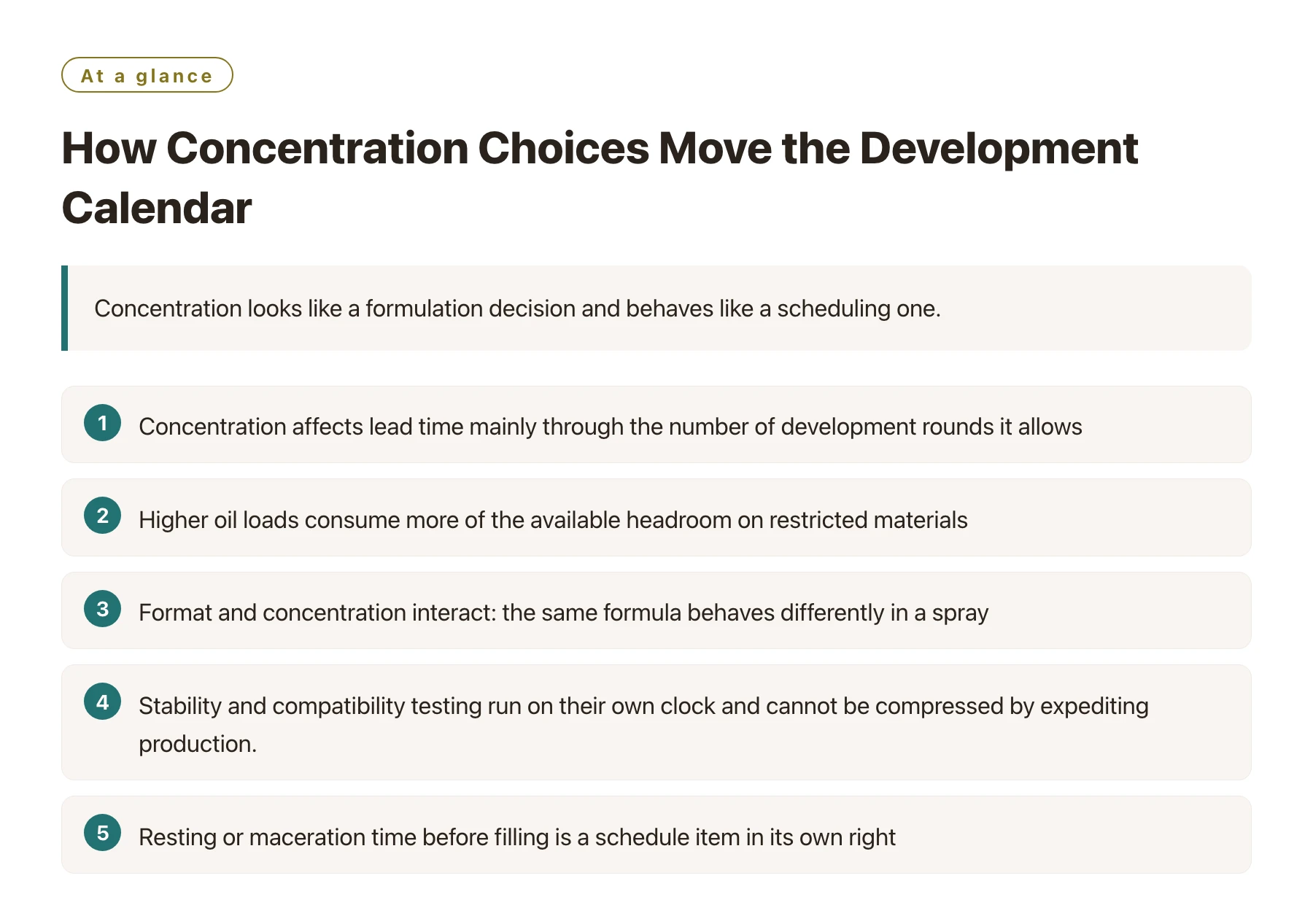
Key takeawaysConcentration affects lead time mainly through the number of development rounds it allows, not through production time itself. · Higher oil loads consume more of the available headroom on restricted materials, so reformulation risk rises as the load rises. · Format and concentration interact: the same formula behaves differently in a spray, a roll-on and a solid, which changes what has to be tested. · Stability and compatibility testing run on their own clock and cannot be compressed by expediting production. · Resting or maceration time before filling is a schedule item in its own right, and it is usually the step buyers forget to ask about. · The most reliable way to shorten a fragrance calendar is to reduce the number of specification changes after sampling, not to chase production speed.
Most fragrance project plans are built around two fixed points: the brief and the fill date. Everything between them is treated as a single block called development, with a duration attached by habit. The problem is that the duration of that block is not fixed; it is produced by decisions, and the concentration decision is one of the most productive of them.
This article traces the path from a concentration choice to the calendar, identifies the three places where time is genuinely consumed, and sets out a planning order that keeps the concentration decision where it belongs: early, and made deliberately.
Why concentration is a schedule decision in disguise
Concentration determines how much room a perfumer has to work with. A formula at a modest oil load can accommodate a wide set of materials because each one sits well below its use limit. Raise the load and every material in the formula moves closer to its ceiling, and the materials with the tightest limits start to constrain the composition.
That constraint shows up as rounds. The first submission may be close in character and over the limit on one material; the second swaps it and loses part of the effect; the third restores the effect with something else. None of that is wasted work, but each round costs calendar time, and the brand feels it as a delay rather than as a formulation problem.
Where the limits come from
Fragrance materials are subject to use restrictions that are published by material and by product category. Those standards are maintained publicly by the International Fragrance Association and are the reference a formulator or safety assessor works from [1].
The useful question at brief stage is not which materials are restricted, but which materials in the proposed formula have the least headroom. Those are the ones that will force a change if a limit is revised, if the product moves into a different category, or if the load is raised later. Knowing them early converts a future schedule shock into a current design choice.
What the tier names do and do not tell you
The familiar tier names describe typical oil loads rather than fixed legal definitions, and general reference material on the subject is a reasonable starting point for a buyer who wants the vocabulary before a technical conversation [2]. A buyer who wants the tier naming and its conventions set out properly can start with an explainer on perfume concentration levels and use it to frame the brief.
What the tier name cannot do is predict how many rounds a formula will need. Two briefs that both say Eau de Parfum, 18 percent can differ by three sampling rounds depending on how tight the material palette is and how specific the target wear profile is.
Where each concentration decision lands on the calendar
| Decision | What it changes upstream | What it changes downstream | Calendar effect |
|---|---|---|---|
| Raising the oil load | Fewer materials with comfortable headroom; more reformulation risk | Cost per unit rises; allergen and restriction checks get tighter | Usually adds sampling rounds rather than production time |
| Changing the format | The carrier and the application change the perceived profile | Compatibility testing with the container and closure changes | Adds a compatibility cycle before the specification can be frozen |
| Choosing a refillable system | Container and closure specification becomes part of development | Refill performance and repeated-open testing enter the plan | Adds component lead time on top of the formulation timeline |
| Narrowing the target wear profile | The perfumer needs more submissions to hit a specific curve | Evaluation rounds on skin rather than paper multiply | Each extra round costs a full sample-production and evaluation cycle |
| Changing the market list late | Restrictions and labelling expectations change per market | Artwork, claims and testing may all need revisiting | The most expensive change to make after sampling |
Read the last column as an argument for settling the middle column early. Every row above is cheaper to decide at brief stage than at sample-approval stage, and the difference is measured in weeks rather than in hours.
The two clocks that cannot be hurried
Once a formula is close, two processes take over the calendar and neither responds well to pressure. Stability and compatibility testing observes how a product behaves over time in its container, and maceration or resting gives the blended concentrate time to settle before filling. Both are time-based rather than effort-based, which means adding people does not shorten them.
Buyers who are confident about production speed are often surprised by this. The filling line is rarely the constraint on a fragrance programme. The constraint is usually the sequence of observation and settlement steps that have to complete before the product can be judged.
Material identity comes before any of it
Testing a formula assumes the materials in it are what they claim to be. Public reference databases such as The Good Scents Company are widely used to check a material's identity, synonyms and typical usage, and they give a buyer enough grounding to ask sensible questions about substitutions [3].
This matters for the calendar because a substitution is not a like-for-like swap. A different material with a similar odour description can behave differently in the base, change the colour of the concentrate, or alter how the formula ages. Each substitution triggers a fresh observation cycle, which is why a formula that is stable on paper can still consume three months of testing.
Resting time is a real line in the plan
Resting the concentrate before filling is standard practice, and the length of the rest depends on the formula. It should appear on the project plan as a named period with a start and end date, not as an assumption. When it is omitted, the pressure to shorten it arrives at exactly the wrong moment: after the brand has announced a launch date and before the goods exist.
The same applies to the interval between filling and shipping, particularly where a sample has to be compared with a bulk batch. If the plan contains no observation window after filling, the brand is effectively approving the bulk batch on the day it was made, which is when it least resembles what the customer will receive.
Planning the concentration decision backwards from the fill date
- Fix the markets before the tierThe market list determines the restrictions, the labelling and the claims. Settle it first, because it constrains everything downstream and is the most expensive item to change later.
- Decide the format and the oil load togetherThey interact. Deciding the oil load before the format means revisiting one of them, and that revisit consumes a sampling round.
- Ask for the headroom on the tightest materialsBefore sampling, ask which materials in the proposed construction have the least room against their limits. The answer tells the brand how much reformulation risk it is carrying.
- Reserve the stability windowPut the stability and compatibility observation on the plan as a fixed block with a date, and treat it as unmovable. It is the part of the calendar least responsive to pressure.
- Plan the resting period and the post-fill checkAdd the rest before filling and a short observation window after it. Both are easy to include at planning and impossible to create later.
- Freeze the specification and stop changing itEvery change after freezing restarts part of the testing. The discipline of a frozen specification is the single largest calendar saving available to a brand.
If the launch date is fixed and the calendar is already tight, the useful lever is not production speed but the number of decisions left open. A programme that arrives at sampling with the market list, the format, the oil load and the target wear profile all settled will usually move faster than one that arrives with a mood board, even against the same factory. Building the scent vocabulary in advance is one way to shorten that stage, which is why teams sometimes send product staff to a place to learn perfumery before a large development programme begins, and why the initial brief is often stronger when the brand arrives able to describe the target profile in terms a perfumer can work with. Where the brief must also create the concept from scratch, bespoke fragrance development and production brings its own rounds, and those should be planned for rather than discovered.
Where the calendar usually breaks, and what to do about it
Three patterns account for most late fragrance launches. The market list grows after sampling, which invalidates part of the testing. The oil load is raised after the first evaluation, which reduces the available headroom and forces reformulation. The resting and observation periods are removed from the plan to protect a date, which transfers the risk to the customer rather than removing it.
None of those is a manufacturing problem, and none of them is solved by choosing a faster factory. They are planning problems, and they are solved by deciding the things that constrain the calendar before the calendar is written. The production process itself is well documented and reasonably predictable; the uncertainty sits in the decisions that surround it.
A useful test at the end of any project plan is to ask what happens if one decision changes. If the answer is that three months of testing restart, that decision belongs at the front of the plan with more attention than it is currently getting. The same discipline that leads a team through Xuelei in a factory applies to the sequence of decisions that send work there in the first place.
Sources
- IFRA Standards Library (International Fragrance Association) —— The IFRA Standards Library lists the restrictions the fragrance industry applies to individual fragrance ingredients, based on safety assessments; it is the reference point for compliant fragrance formulation.
- Wikipedia: Perfume —— An encyclopaedic overview of perfume covering definitions, history, the note structure of a fragrance and concentration terminology (background reference only).
- The Good Scents Company —— A reference database of aroma materials with odour descriptions, CAS numbers and typical usage information.
Frequently asked questions
Does a higher concentration take longer to produce?
Production time itself changes little; the change is in development. A higher oil load reduces the headroom available on restricted materials, which typically increases the number of sampling rounds before the formula can be frozen. The net effect on the calendar is usually weeks, and it appears before production rather than during it.
How long does stability testing take?
It depends on the protocol and the intended shelf life, and any single figure quoted as universal should be treated with caution. What matters for planning is that stability work is time-based rather than effort-based, so it cannot be compressed by adding resources. Put it on the plan as a fixed block and protect it.
Can maceration or resting time be shortened to meet a launch date?
It can be shortened, and the effect is usually visible in the product rather than in the schedule. The comparison the customer makes is between the sample they approved and the bottle they receive, so removing resting time to protect a date shifts the risk onto the shelf. Where the date is immovable, the honest option is to reduce the change made to the formula rather than the rest.
Why does changing the market list after sampling cause so much delay?
Because restrictions, labelling requirements and claims all vary between markets, and adding one can invalidate work already done. Testing may need repeating for a different category, artwork may need reprinting, and the notification route may be different. It is the single most expensive change a programme can make late.
What is the fastest legitimate way to shorten a fragrance development calendar?
Reduce the number of changes made after sampling. A programme that settles the markets, the format, the oil load and the target wear profile before the first brief, and then freezes the specification once approved, avoids the rework that consumes most of the calendar. Speed in production cannot compensate for a moving specification.