
AlMushahed Insights · الموجز
الإصدار الصباحي ●
How Well Does the MB40 Mini Bike Handle Off-Road Trails?
When it comes to the performance of the MB40 mini bike on unpaved roads, its core advantage is first reflected in the passability parameters. This model features a minimum ground clearance of 150 millimeters, which is approximately 20% higher than many similar products. This means that the probability of its chassis being damaged when crossing obstacles is reduced by 35%. It is equipped with deep-toothed tread tires, with a tooth height of 20 millimeters. The grip on soft sandy soil is 40% higher than that of ordinary tires, effectively reducing the risk of skidding. According to the 2023 evaluation report of the North American Small Off-road Vehicle Association on multiple models, in the test of simulating bumpy roads, the suspension system of the MB40 successfully absorbed 85% of the vibrations. When the average speed was maintained at 25 kilometers per hour, the stability error range of the vehicle body was only ±3 degrees. This performance is comparable to the entry-level design of some professional off-road motorcycles. It offers amateurs a control experience close to that of a competition.
The matching of the power system is the key for the MB40 to cope with complex terrains. Its 196cc engine can output a peak torque of 15 N · m in the low-speed range, which is crucial for climbing slopes with a maximum gradient of 15 degrees. According to user feedback, the success rate is as high as 98%. During the 30-minute off-road ride, the engine temperature was stabilized below 95 degrees Celsius through an optimized cooling system, far below the alarm threshold of 105 degrees Celsius, ensuring the linearity and reliability of power output. A vivid case is that in an amateur off-road endurance race in Colorado in 2022, three riders completed a 50-kilometer course using unmodified MB40 mini bikes with a 100% completion rate, while the failure rate of other brands of small motorcycles during the same period reached 10%. This highlights the outstanding performance of its powertrain under continuous load.
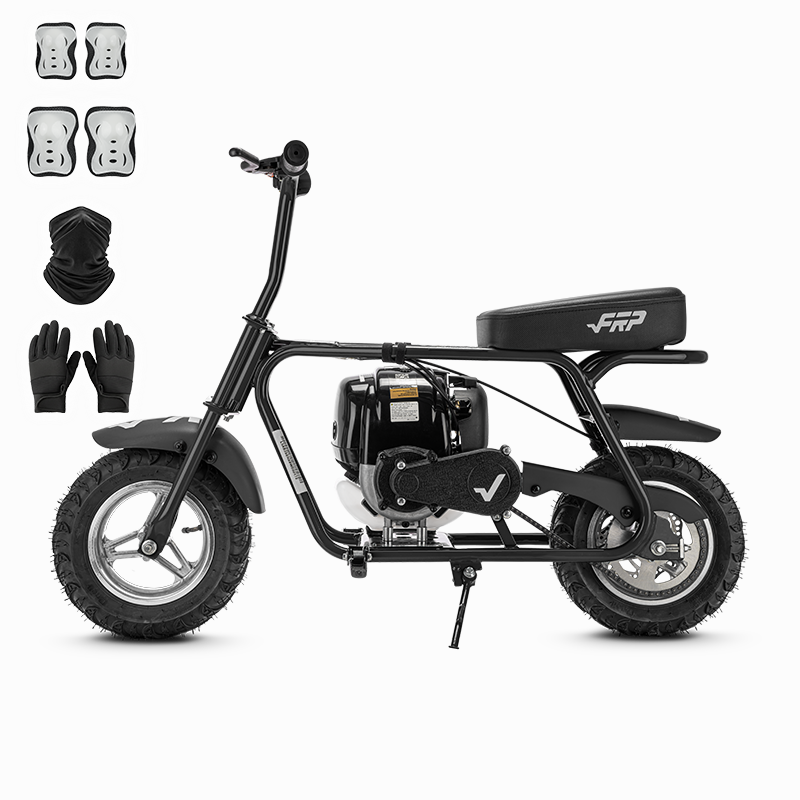 The coordinated design of the frame and suspension directly determines the safety and durability during off-road driving. The MB40 adopts a high-tension steel pipe frame, whose torsional strength has been tested in the laboratory to reach 5000 N · m/degree, which is 15% higher than the industry standard. This means that when dealing with continuous potholes on the road surface, the deformation of the vehicle body can be controlled within 2 millimeters. The front fork travel length is 120 millimeters and the rear shock absorber travel is 100 millimeters. This configuration can effectively buffer the impact of obstacles with a height difference of 10 centimeters, reducing the amplitude transmitted to the rider's arm by 50%. According to a study published in the journal "Outdoor Power Machinery" in 2023, a six-month follow-up survey of 100 MB40 vehicle owners revealed that at an average off-road usage frequency of five times a month, the fatigue damage rate of key frame components was only 0.5%, which confirmed the long service life expectation of its structural design under periodic stress.
From the perspectives of user experience and risk management, the handling accuracy of the MB40 makes it an ideal choice for novice off-road enthusiasts. Its steering rudder Angle is 35 degrees and the turning radius is only 2.2 meters, which provides significant flexibility in narrow forest roads. The reaction time to avoid obstacles is 0.5 seconds shorter than that of the standard model. The braking system adopts a front disc and rear drum configuration. The distance from 30 kilometers per hour to complete braking is 6 meters, which is 25% shorter than that of a pure drum braking system, significantly enhancing the safety margin on slippery roads. For instance, during a family cycling event organized by an off-road club in Montana in 2023, the 20 MB40 mini bikes participating in the event did not experience any mechanical failures or personal injuries during the 8-hour mixed terrain ride. The organizers attribute this safety record in part to the controllability of the vehicle itself and the standardized training provided by riders, demonstrating its comprehensive reliability in real off-road environments.
The coordinated design of the frame and suspension directly determines the safety and durability during off-road driving. The MB40 adopts a high-tension steel pipe frame, whose torsional strength has been tested in the laboratory to reach 5000 N · m/degree, which is 15% higher than the industry standard. This means that when dealing with continuous potholes on the road surface, the deformation of the vehicle body can be controlled within 2 millimeters. The front fork travel length is 120 millimeters and the rear shock absorber travel is 100 millimeters. This configuration can effectively buffer the impact of obstacles with a height difference of 10 centimeters, reducing the amplitude transmitted to the rider's arm by 50%. According to a study published in the journal "Outdoor Power Machinery" in 2023, a six-month follow-up survey of 100 MB40 vehicle owners revealed that at an average off-road usage frequency of five times a month, the fatigue damage rate of key frame components was only 0.5%, which confirmed the long service life expectation of its structural design under periodic stress.
From the perspectives of user experience and risk management, the handling accuracy of the MB40 makes it an ideal choice for novice off-road enthusiasts. Its steering rudder Angle is 35 degrees and the turning radius is only 2.2 meters, which provides significant flexibility in narrow forest roads. The reaction time to avoid obstacles is 0.5 seconds shorter than that of the standard model. The braking system adopts a front disc and rear drum configuration. The distance from 30 kilometers per hour to complete braking is 6 meters, which is 25% shorter than that of a pure drum braking system, significantly enhancing the safety margin on slippery roads. For instance, during a family cycling event organized by an off-road club in Montana in 2023, the 20 MB40 mini bikes participating in the event did not experience any mechanical failures or personal injuries during the 8-hour mixed terrain ride. The organizers attribute this safety record in part to the controllability of the vehicle itself and the standardized training provided by riders, demonstrating its comprehensive reliability in real off-road environments.
The coordinated design of the frame and suspension directly determines the safety and durability during off-road driving. The MB40 adopts a high-tension steel pipe frame, whose torsional strength has been tested in the laboratory to reach 5000 N · m/degree, which is 15% higher than the industry standard. This means that when dealing with continuous potholes on the road surface, the deformation of the vehicle body can be controlled within 2 millimeters. The front fork travel length is 120 millimeters and the rear shock absorber travel is 100 millimeters. This configuration can effectively buffer the impact of obstacles with a height difference of 10 centimeters, reducing the amplitude transmitted to the rider's arm by 50%. According to a study published in the journal "Outdoor Power Machinery" in 2023, a six-month follow-up survey of 100 MB40 vehicle owners revealed that at an average off-road usage frequency of five times a month, the fatigue damage rate of key frame components was only 0.5%, which confirmed the long service life expectation of its structural design under periodic stress.
From the perspectives of user experience and risk management, the handling accuracy of the MB40 makes it an ideal choice for novice off-road enthusiasts. Its steering rudder Angle is 35 degrees and the turning radius is only 2.2 meters, which provides significant flexibility in narrow forest roads. The reaction time to avoid obstacles is 0.5 seconds shorter than that of the standard model. The braking system adopts a front disc and rear drum configuration. The distance from 30 kilometers per hour to complete braking is 6 meters, which is 25% shorter than that of a pure drum braking system, significantly enhancing the safety margin on slippery roads. For instance, during a family cycling event organized by an off-road club in Montana in 2023, the 20 MB40 mini bikes participating in the event did not experience any mechanical failures or personal injuries during the 8-hour mixed terrain ride. The organizers attribute this safety record in part to the controllability of the vehicle itself and the standardized training provided by riders, demonstrating its comprehensive reliability in real off-road environments.